6G-TERRAIN MSCA Doctoral Network Successfully Completes Online School Series 1 & 2
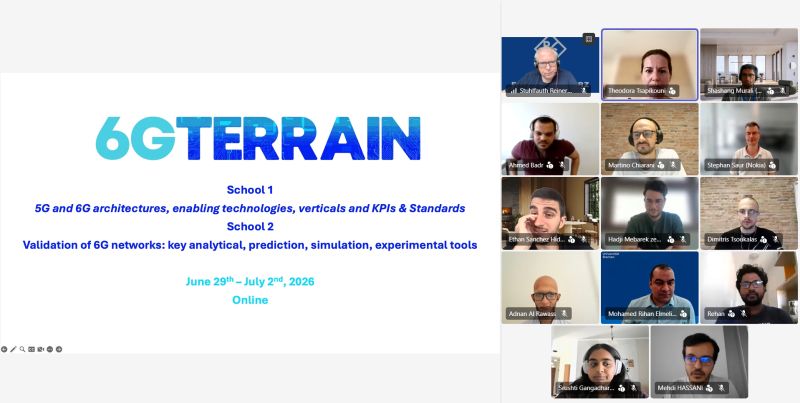
The 6G-TERRAIN MSCA Doctoral Network has completed its first two training schools, marking an important milestone in the project’s educational programme. Conducted entirely online over four days, Schools 1 and 2 brought together the network’s Doctoral Candidates for an intensive learning experience focused on the latest developments in 5G and 6G technologies.
The programme featured a series of expert lectures delivered by distinguished speakers from leading universities, research centres, and industry partners. Throughout the sessions, Doctoral Candidates actively participated in discussions, exchanged ideas, and engaged with the speakers through insightful questions, demonstrating a strong commitment to expanding their knowledge and research skills.
School 1: 5G and 6G Architectures, Enabling Technologies, Verticals, KPIs and Standards
The first school explored the technological foundations shaping the future of 6G communications. Participants gained insights into the evolution of Non-Terrestrial Networks (NTN) beyond 3GPP Release 17, satellite-terrestrial network integration, device-to-device (D2D) communications, and key challenges in test and measurement.
The programme also addressed AI-native networks, Integrated Sensing and Communications (ISAC), and the convergence of sensing, computing, and communication technologies. Particular emphasis was placed on the role of NTN as a key enabler of future 6G systems and its integration with artificial intelligence and advanced network architectures.
The sessions were delivered by experts from Rohde & Schwarz, Nokia, TESAT, Bosch, and Aalborg University, providing participants with valuable perspectives from both academia and industry.
School 2: Validation of 6G Networks – Analytical, Simulation and Experimental Tools
The second school focused on methodologies and tools for validating next-generation wireless networks. Participants were introduced to digital twin-based experimentation using OpenAirInterface, Open RAN and AI-RAN architectures, as well as practical demonstrations involving 5G Core and Radio Access Networks, monitoring frameworks, and xApp development workflows.
In addition, the programme explored the emerging role of Agentic AI in enabling autonomous network control and optimisation, highlighting the transition towards open, AI-native, and reproducible experimentation platforms for future 6G research.
The training was delivered by experts from EURECOM, Allbesmart, and i2CAT Research Centre, offering participants hands-on insights into cutting-edge research and innovation.
Looking Ahead
The successful completion of Schools 1 and 2 has equipped the 6G-TERRAIN Doctoral Candidates with valuable knowledge, practical skills, and a deeper understanding of the technologies that will shape future communication networks.
The consortium looks forward to the upcoming training schools, which will continue to strengthen the Doctoral Candidates’ academic, technical, and professional development while fostering collaboration across the 6G-TERRAIN network.